
The new Architecture of work
Over the last year or so, our deal flow at Acadian Ventures has significantly improved, mainly due Audrey’s efforts. She has been able to access brilliant founders that Jason and I didn’t know about. She seems to know the start up scene in London and Paris inside-out and she is now doing the same in New York.
We have also been developing our thesis as our firm grows: While HR-Tech remains a central component, we see the impact of AI, beyond the HR function, into the broader back-office. Where people and agents collide and collaborate creates new opportunities for us as investors. We are also excited about new combinations of software and service. AI enables the move to outcome based solutions that either augment or disrupt more traditional administrative service companies.
We call this the new architecture of work. We also reluctantly use the term WorkTech.
Gradient team
Audrey discovered the Gradient team almost immediately after the founders got together to build something new. There is more AI centric work going on in Paris than first meets the eye.

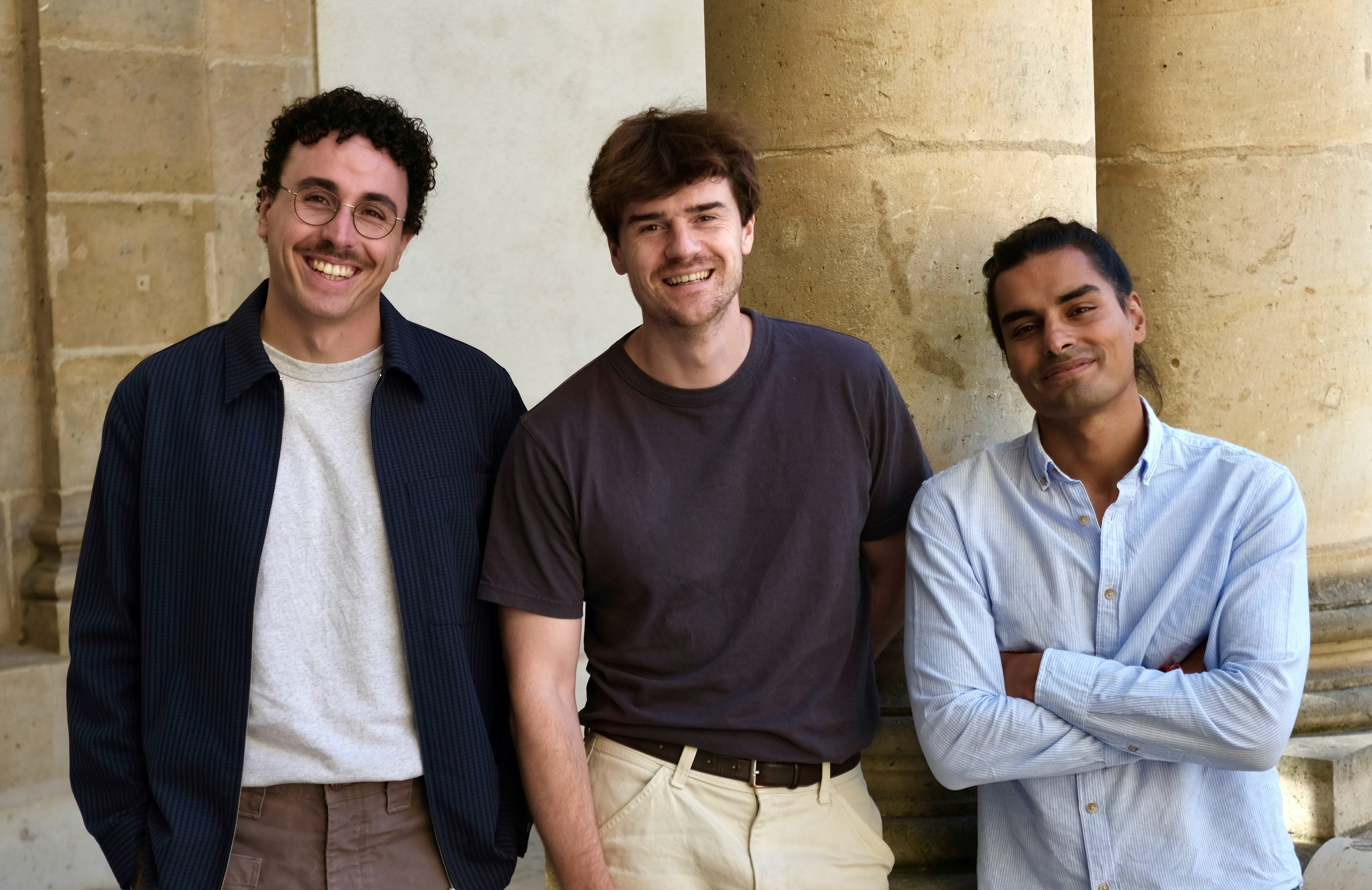
At pre-seed, the team is the most fundamental part of the investment. And this is a brilliant founding team, Rohan Krishan Alexandre Sauvage and Arthur Himmel. The chemistry between them is strong, and there is a pleasing mix of commercial nouse, subject matter knowledge and very strong technical chops.
Rohan studied Finance and Data Science at HEC, and then worked in the finance function at Alan, a fast growing French scale up. There he got to understand the challenges of operational finance, and was an early adopter of AI automation.
Arthur worked together with Rohan at Alan, and also helped to scale Pivot. He has deep technical AI skills, and has been applying them in the finance function. He has an MSc in software engineering from Lille.
Alexandre studied at HEC and Esade, majoring in International finance and innovation. He then worked at Remote, scaling operations and GTM.
We really like European founders with global ambition. The team is split between Paris and New York, but we look forward to seeing them everywhere.
The team knew they wanted to radical process improvement in the back-office, and after various experiments and 100s of client interviews, they decided to focus on rethinking the accounting firm at a fundamental level. We worked with them on the brain storming, but they did 99% of the figuring out. We kept the deal quiet until Gradient was ready to launch, and today is the day.
We are pleased to be co-investing with Venture Friends TinyVC, Heartfelt, and Kima Ventures. Gradient’s pre-seed round.
Defining the problem
VC backed founders1 hire an accounting firm for one reason: peace of mind. So they can focus on building a category-defining company. Yet too often, accouting firms fail to deliver that peace of mind. Founders are left guessing at the burn rate, worrying about tax filings, and paying for hours that shouldn’t exist.
The root cause is structural and comes down to two things.
(i) Fragmented data. To deliver high-quality accounting, you need clean, accessible data. That holds true whether you’re closing the books, filing taxes, or answering urgent client questions. Yet most firms operate in a way that leaves information scattered across banks, payroll, credit cards, invoicing tools, cap tables, and tax systems. An accountant is only as good as the data they can access. When that data is fragmented, bookkeeping becomes less reliable, tax deadlines get missed, and answering a simple customer question can take far too long.
(ii) Misaligned incentives. Traditional firms are built around billable hours, so they are rewarded for time spent rather than for solving the problem efficiently. That shapes behavior. There is little incentive to remove unnecessary work, streamline processes or make the service radically more efficient. Attention also naturally goes to the clients generating the most billable hours, rather than necessarily to the ones who need the fastest or best support. The model rewards activity, not outcomes.
The result is that accounting becomes another task for the founder to manage: repeatedly answering the same questions, chasing down their accountant, tracking deadlines themselves, and sometimes discovering mistakes months after the fact.
Accounting firms are adopting AI. Tools like Basis and Accrual make accountants faster: they are copilots, sold to firms. But founders still buy the same thing, hours from a firm whose model hasn’t changed. Gradient and we believe that gets the opportunity backwards.
Focusing on service quality changes how the whole firm is designed. Two shifts make this possible now. AI can finally do the rule-based work of accounting reliably, and the profession is shrinking: the US has lost roughly 340,000 accountants in five years, and most CPAs are nearing retirement. Nothing like a demographically induced sense of urgency.
Rebuilding the accounting firm
Gradient threw out the traditional operating model and rebuilt the firm model from scratch, answering this simple yet structural question:
“How do we provide the best possible service to founders leveraging the latest AI capabilities?”
Accounting work splits into two kinds: intelligence and judgment. Reconciling, categorizing, and preparing filings follow complex rules, but they are rules. Deciding how to treat an edge case, what to flag to a founder, and what to sign takes judgment.
AI does the intelligence work, acting as a staff team.
CPAs and accountants focus exclusively on judgment: review, decisions, and accountability.
One team executes, the other decides and owns the outcome.
The result is a fundamentally different accounting experience for founders: faster answers, more reliable books, proactive tax and compliance management, and almost no time spent managing accounting. They finally get what they hired an accounting firm for in the first place: peace of mind.
First, by eliminating data fragmentation, Gradient’s accountants have the full context at all times. They can answer questions quickly, spot issues earlier, and stay ahead of deadlines.
Second, our agents run continuously, not at month-end. Gradient reconciles the books on a daily-basis and watch for new tax and compliance obligations the moment they appear: economic nexus reached in a new state, a first hire in a new state triggering payroll registrations, a filing threshold crossed, etc. Issues surface when they happen, not months later.
Third, by removing billable hours, Gradient eliminates the incentive to maximize time spent. The teams are rewarded for delivering the right outcome efficiently, not for generating more work: founders pay a flat fee for a defined scope, never by the hour.
Early adopters and ambition
The Gradient team has focused on early stage startups to date. As European founders expanding and establishing in the US, they have gained great early traction with founders facing this challenge. The founders have deep empathy and understanding of what international founders face.
Early momentum: Founders backed by a16z, YC, Liquid 2 and other leading investors have already switched to Gradient. More than $40M in transactions have been reconciled without human touch, books closed within the same day, and founders get expert answers in under 5 min. Every tax return is prepared within 2 days and signed by licensed CPAs. And this is only the beginning. While Gradient is starting with early-stage startupsm their is a plan to expand to growth-stage companies and, eventually, other professional services.
The long-term ambition is to build a firm capable of challenging the large professional-services firms everyone knows today.
Finally
I’m really pleased to see how the Gradient team has deeply researched what they want to build. This was an iterative process, and this willingness to learn and adapt at the pre-seed stage is vital. Winning early customers in the US, and now feeling the pull for what they have built, it’s the time ft make some noise.
As I almost always do, here’s a tune to end the post. The Gradient team have both the brains, brawn and looks.
More on the deal here.
https://techfundingnews.com/exclusive-gradient-raises-4m-ai-native-accounting-firm-us-startups/
I adopted this section from the Gradient briefing note.