

I have been a bit slow in posting after our Carlsbad Summit, but the writing mojo is creeping back. The event went better than I could have imagined, judging by the feedback from founders, investors and industry executives. A massive thanks to all that attended, and especially to the panelists across the two days.
On day one I spoke for 20 minutes about what we believe is happening in worktech. The challenge when talking for 20 minutes is not what to say, but what not to say.
I will dip into the presentation and into the some of the panel discussions over the next few posts. We will post some of the presentations too, so that you can watch them.
AI and Jobs
I spent the first few minutes on the the AI and jobs question. I’ve read widely and written a far bit about the likely impact of AI on jobs over the last few years. Here’s what I wrote last year.

Understanding and exploring this is really at the centre of worktech today. There’s a lot of posturing in our industry, and it isn’t really helping.
Here’s the talk section, edited for clarity and some brevity.

I’ll mention Jevon’s Paradox. It’s a secret rule that we have in the venture capital community that you have to mention Jevon’s Paradox at least once a day. Somedays it seems the most important theme in venture capital is Jevon’s Paradox. He was an economist, did some studies on the coal industry in the UK in eighteen sixty-five. He looked at the invention of the steam engine: James Watts’ steam engine, and the impact that it was gonna have on the on the economy. And there was a lot of doom and gloom at the time, but he actually came up with the with the theory that that as the cost of an of an invention (energy) comes down, rather than creating unemployment, it actually has the opposite effect because people think of new ideas and new ways of new ways of doing things. And that’s what that fancy graph over there tells us.
That’s as much economics as I’m going to go into because I did economics at university and then I nearly failed because there was a pool tournament on the night before the exams. And I thought that I would get knocked out in the first round of the tournament and then I could cram my Samuelson Guns and Butter stuff for the exam, but I actually did quite well in the pool tournament and I kept kept winning. And so I had that choice at one stage of the night, do I carry on playing pool or do I work on my economics and for that night pool won. So I’m not promising a great game tonight, but if I do see you on the table, I was a bit of a hustler long ago.
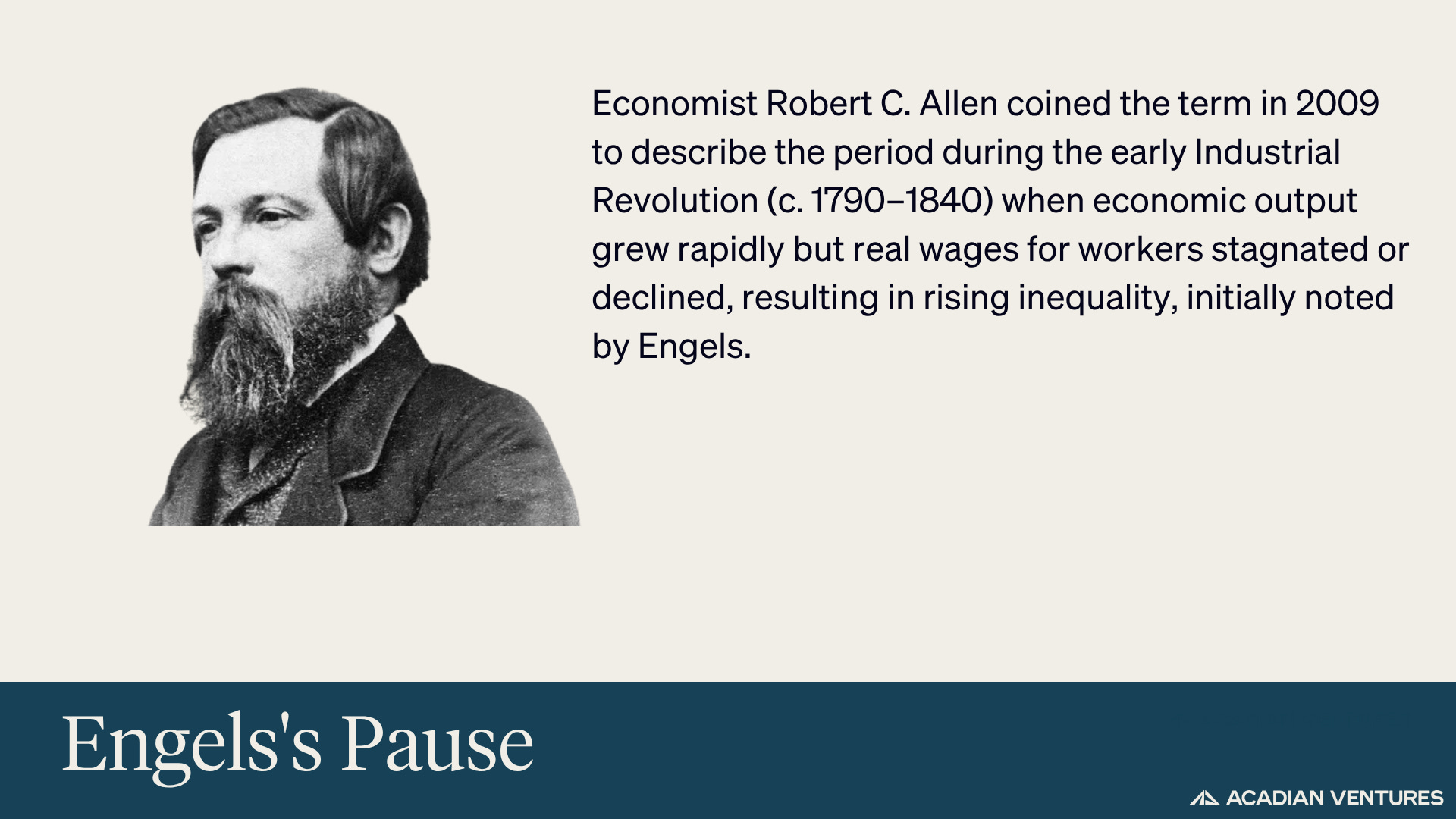
I’m probably the only venture capitalist that’s ever mentioned Frederick Engels (said half in jest). He was Marx’s best mate. Engels was interesting in part because because he had a rich dad. So he funded a lot of Marx’s research. But he himself was actually a very significant researcher in early capitalist economics, and he tends to be forgotten, but I think he did a lot of very interesting work. More recently, a modern economist, Robert Allen, picked up on Engels’ idea. One of the things that Engels was saying is that when you have new technology taking over traditional work of people, then it does create unemployment (or downward wage pressure). So you have this tension, if you like, between the Jevon’s paradox and what what what Engels was saying and Alan named this thing the Engels pause.
I think that’s what we’re dealing with at the moment: We’re having to deal with both of these things continuously. We see this great potential opportunity to create new jobs, new ways of working, new ways of thinking, new types of businesses, new business models. But at the same time, for many people, AI is creating fundamental disruption. Those of you that have kids at the moment going into the workplace will feel that will feel that viscerally in the challenges that younger people have today, in finding jobs.
So my point here about the economics of the future of work is that it’s complicated. And there are no simple answers about how AI is going to impact work. And actually I think it’s how people take decisions. Are they in the world of looking to save costs by reducing labor, or are they looking at a world of imagination?
I’m hopeful that we will move more and more to that world of imagination than that world of simply looking to cut costs. But I think a lot of VCs will oversimplify this and there one day there will be the doom and gloom side of the equation, the other day will be the sunny side of the equation. But the reality sits somewhere in between.
Posturing and peddling back.
Over the last few weeks we have seen founders and CEOs positioning both arguments. Some slash headcount with callus abandon, labelling swathes of people less worthy, Cloudfare being a recent example. For many AI has been a handy foil for repackaging reorganizations.
Others are doubling down on hiring, for instance IBM has massively increased its graduate hiring.
Leaders of frontier model companies and several vocal VCs are peddling back some of their claims about AI’s ability to take vast swathes of white collar jobs in the short term. While this retreat to a more fact-based position is welcome, their rhetoric has created significant harm to the careers of many people, especially those looking to enter the job market. Sentiment matters, the fear is real.
This week’s Economist explores the same theme, I wish I’d read it before my talk.
IKEA doing it right
Later on day two, David Wright, the Chief Innovation officer at ServiceNow, described one of IKEA’s AI efforts.
IKEA deployed an AI agent named Billy that successfully automated 57% of customer support inquiries. Instead of treating this as a cost-cutting cue to slash headcount, IKEA took 8,500 customer service reps and upskilled them into Remote Interior Design Consultants.
By automating cold execution, they liberated human creativity. That single pivot turned a traditional cost center into a massive growth engine, generating $1.4 billion (€1.3B) in net-new revenue in its first year. (See Sunil’s post for more)
Making a stand
On the final panel on day two, we had several HR leaders talk including the former CHRO of Disney, John Renfro. (edited for brevity). This session was gold.
I think one of the things that I’m most disappointed about that I’d like to see us correct is the treatment of people as people as re-orgs happen. So, you know, day to day we hear about the layoffs and the panic. I think one out of five employees thinks their job will be impacted in the next five years.
A lot of people are worried. College grads are worried, but some are hustling more than others. So I mean people are still getting jobs and it’s exciting to see.
And we watch CEOs and CFOs on a Friday night Zoom call where HR might not have been on that call, decide we’re doing a layoff on Monday. And we’re we’re just gonna send people emails at 2 a.m. We’re not gonna tell their direct boss, and we let it fly. And these aren’t just companies, these are the most profitable companies in the world. What in the world? So if that’s the model, please break that trend.
So that’s something I’m really worried about. That culture does matter. Culture can be a competitive advantage. And since that human capital voice probably wasn’t on that Zoom call in the middle of COVID, culture was de-emphasized. And they will pay a long-term price for generations, probably. That’ll be a reference point of remember back when this happened.
I don’t wanna see people dehumanized. So I think that’s something in the next two years. I think we’re gonna see that come back. I’m not saying that we’re I see it coming back yet. And I’m a little worried when I hear that AI is determining who’s gonna get laid off. And I’d say, based on what? My calendar density, my number of keystrokes, the articulation that I give an AI bot that get you know, rated and that I get on a a layoff list because of these tactical short term views where maybe a comment in a verbal meeting at late at night might have changed the direction of a a big divisional acquisition is not brought into consideration. So I’m concerned how AI is implemented in some firms just for efficiency.
And I think both of these, the empathy and understanding for associates and using AI correctly when we do performance and potential evaluation is critical, and I hope that will change in the next two or three years.
While he wasn’t at the event, it is worth quoting the Pontiff. I wasn’t expecting the Pope to weigh in on AI, and I found myself in agreement with his underlying humanist position. (I might have to do another post on the Magnifica Humanitas).
Developers bear a particular ethical and spiritual responsibility, for every design choice reflects a vision of humanity
The pursuit of greater profits cannot justify choices that systematically sacrifice jobs, because the human person is an end, not a means, and the economic order must remain subordinate to human dignity and the common good.
The CEO of Lattice, Sarah Franklin, posted a pithy comment this week. People aren’t tokens. Watch this interview too.
Several of our founders have been articulating a strong human centric approach to AI, For instance Michael at Arist.
We need a more humanist approach to how AI impacts talent.
The discourse around AI and work has been almost entirely focused on two questions: how do humans get replaced by AI, and how do humans do 10x more work with AI.
Both miss the most important and the most fundamentally humanist question: how do humans achieve their fullest potential with AI?The enterprises that win the next decade won’t be the ones that adopted AI fastest or replaced their workforces the fastest. They’ll be the ones that used it to genuinely understand their people and enable them to reach their fullest potential.
Using AI to help people reach their fullest potential. Well said.
In the next post I’ll explore the insurgent v incumbents discussion, the SaaS apocalypse and more.
As I usually do, here is a tune. Speaking of Apocalypses…..
The FOMO was real, your event looked incredible. Massive kudos, events aren't easy (I have the scars).
And the pool tournament is gold.
Thomas Otter - this is such a thoughtful set of ideas to share. Thank you! I love the last comment you shared from Michael at Artist: Using AI to help people reach their fullest potential. Wow, that is the kind of visionary and generative thinking we need more of.