
Today, SAP announced at SAP SuccessConnect that it has agreed to acquire TechWolf, subject to the usual regulatory approvals. Terms of the deal won’t be disclosed, but this the largest acquisition of a venture backed company in Belgian history, and the country’s largest employee liquidity event to date.
Acadian Ventures is an early investor1 in TechWolf, and we have had the privilege to work with the founders (Andreas, Mikaël and Jeroen) since shortly after company inception. This is the second Acadian portfolio company to be acquired by SAP (SmartRecruiters was the first). This deal is a further vindication of our investment thesis for the new architecture of work (see also our fund announcement).
The founders and investors are contributing 3% of the proceeds to the TechWolf foundation, a charity to support causes aligned with TechWolf’s mission, making work better and fairer for millions of workers around the globe.
Executive Summary
While at first glance this seems like a straightforward Human Capital Management (HCM) play, it is a strong signal of how the enterprise software stack will be rebuilt to manage and empower both humans and agents.
The acquisition immediately makes SAP more competitive in the 80 Billion dollar HCM market.2
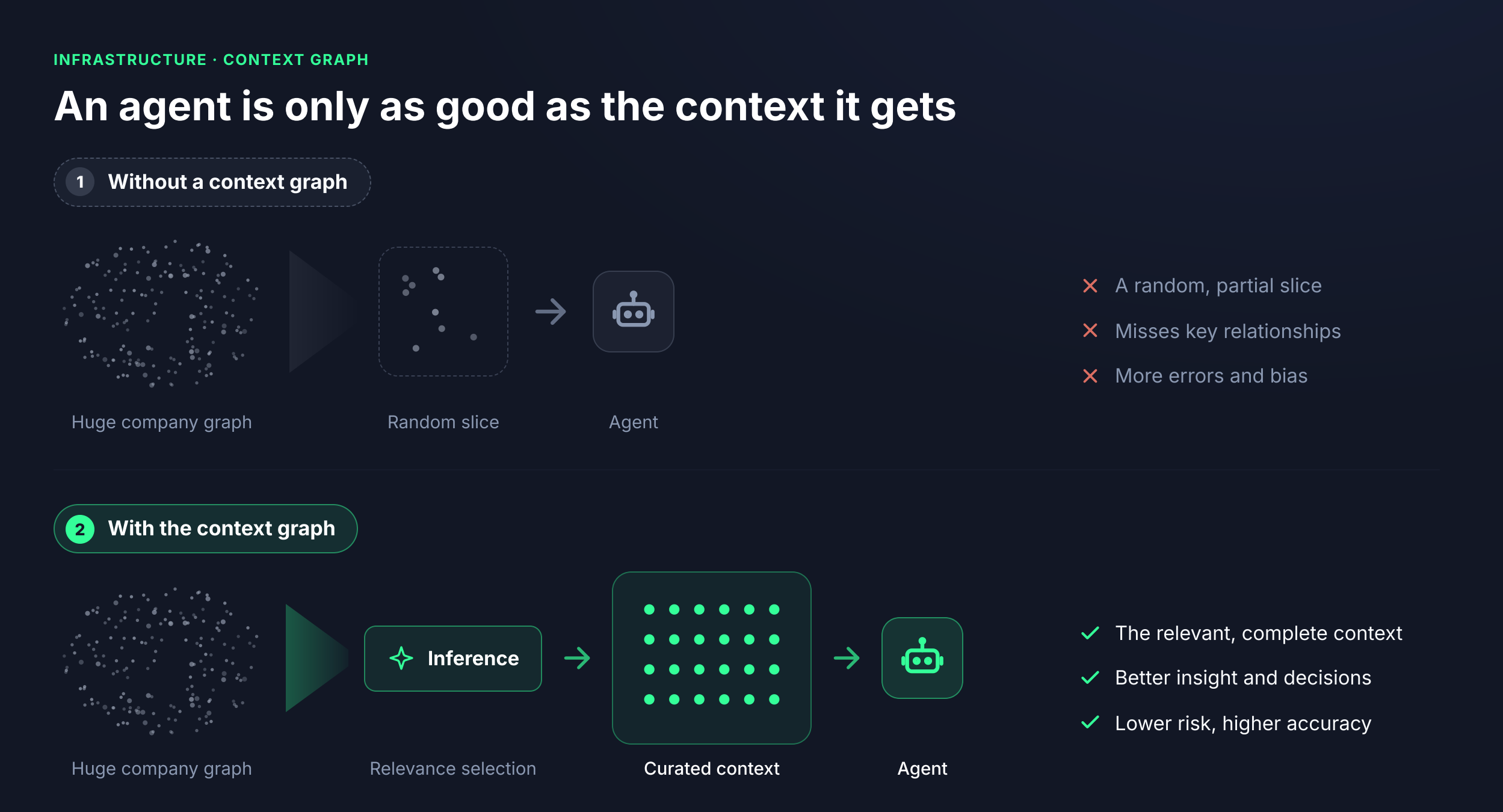
Without deep people, work, jobs, tasks and organizational context, agents can’t be trusted to perform reliably or consistently in production and at scale.
AI transformation is not merely technical. It is a profoundly human endeavour. It forces companies to rethink the very foundations of work, workplace and organizational design. TechWolf was built for this.
We predict that TechWolf will become a key component of SAP’s broader AI strategy and infrastructure. It aligns well with other SAP acquisitions such as SmartRecruiters, Dremio, Reltio, Prior Labs, and Signavio.
So why did SAP buy TechWolf?
An obvious reason: Improving HCM competitiveness.
TechWolf is the most successful enterprise skills intelligence company in the world. Over the last 18 months it grew 15x in the US, closing 7 figure deals at several Fortune 100 companies. It helps solve an acute problem for the HR function, understanding what skills people have, and how the organization makes use of them. It has the trust and attention of CHROs. Once embedded, the product has very high levels of stickiness and utility. Unlike many vendors that promise skills data and matching, TechWolf actually works. Its ability to derive skills and organization data through inference from systems beyond HCM is profoundly differentiating.
I’m not going to provide anything more than a superficial commentary of the product here. The company website does a competent job in describing the three pillars of today’s product. Skills Intelligence, Work Intelligence and Market intelligence. If you are unfamiliar with the products, I suggest you have a play with the Work Intelligence Index. I will explore the new agentic capabilities and opportunity later in this post.
TechWolf’s customer base includes some of the most world’s complex organizations, right in SAP’s sweet spot. SuccessFactors customers running include Atlas Copco Group, KLM, Ericsson, Arla Foods, AMD, UCB, Chiesi and HSBC (who liked it so much they invested). Leading SIs and consulting firms are building out Techwolf competence too, further strengthening reach and deployment capability.
So it massively improves the competitiveness of the SuccessFactors product, and it gives the SAP field a meaningful product to sell into customers that have a mix of SAP ERP and other HCM vendors, such as Workday, UKG, and Dayforce.
It significantly strengthens the AI chops in SuccessFactors product and engineering.
The SmartRecruiters deal gave SuccessFactors a best in class ATS / talent acquisition solution, solving a long standing product weakness. The integration has gone well so far, so TechWolf can leverage this PMI team. There are also AI and functional synergies between TechWolf and SmartRecruiters that significantly enhance both products. SAP field machine will be able to scale TechWolf far more rapidly than TechWolf could as an independent company.
If that were the only reason, it would be a prudent move. But the HCM centric element, important though it is, is only small part of the story.
There is more at play: Context layers, AI transformation and moving beyond the HR buying centre.
At the Acadian Ventures Annual Summit, We declared context layer to be the word of the year. Much of the VC industry did the same.
On agents
There is a massive feeding frenzy to build agents that work with enterprise software such as SAP. It is not yet clear who wins. While there has been significant progress in building agentic capabilities, in part by the foundation models, startups and even incumbents, the missing ingredient is the precise context of what people know and can do. In building out the skills intelligence foundation Techwolf has built the richest ontological layer about the work people do.
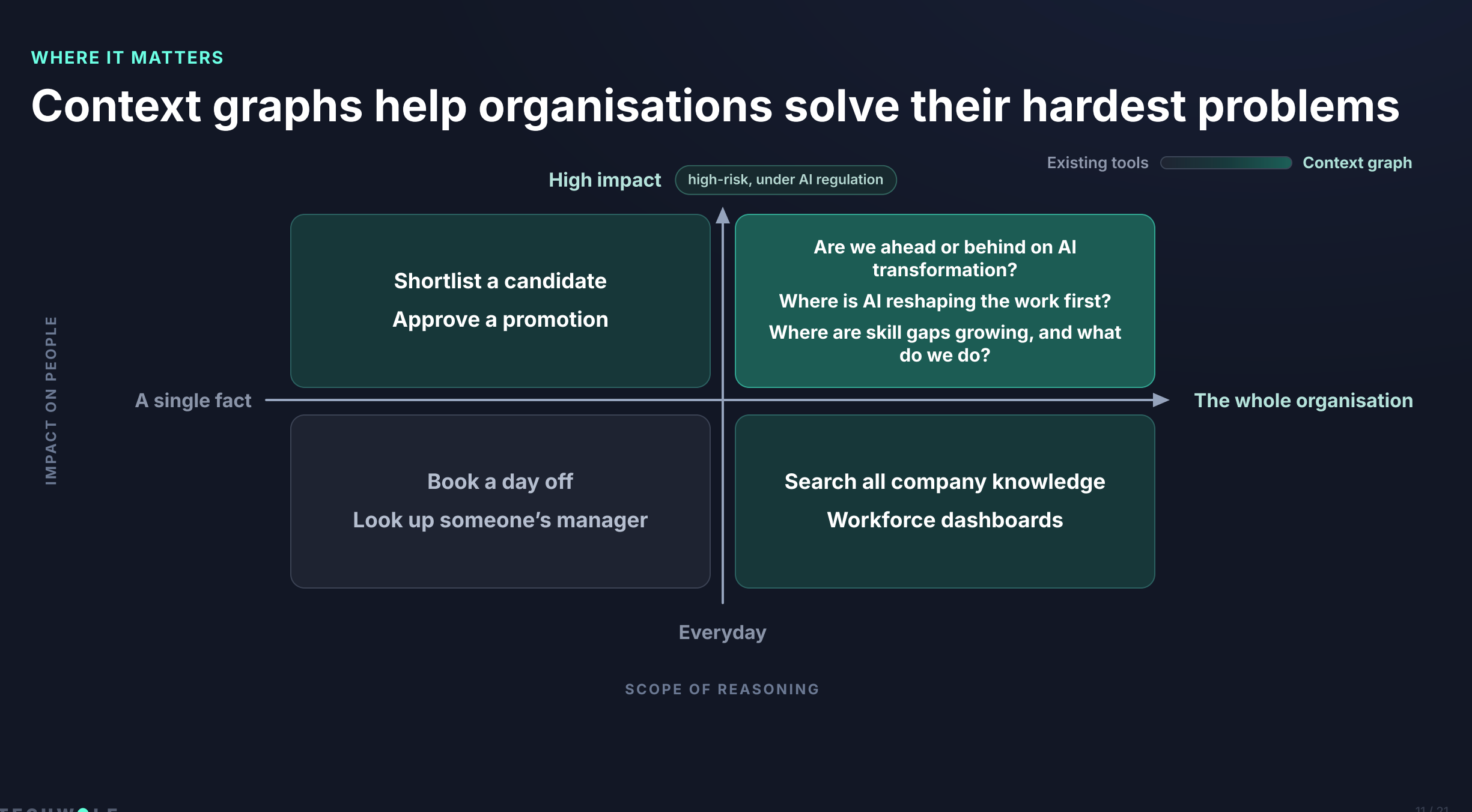
While this has implications for HCM systems, the opportunities beyond HR are several fold. This deep understanding of the context graph has enabled TechWolf to build specialized agents for processes such as strategic workforce planning. Despite decades of attempts by many vendors to build applications, workforce planning has stubbornly remained on spreadsheets. Agents that can navigate organization context and broader enterprise systems will change this.
Many workforce processes are considered high risk under the EU AI Act, and the growing plethora of state level regulation in US will require organizations to manage workforce data securely, transparently and fairly. TechWolf took GDPR seriously for from day one. Building this is not something a foundation lab or a vibe coder can cook up overnight.
Mapping jobs, tasks, skills and organization is fiendishly complex. Just throwing it into an LLM and hoping for the best fails, as many vendors have found out at their customer’s cost.
Essentially Techwolf chose to team up with SAP because the AI transformation is a transformation of work. Most evidence of how work gets done today sits in operational systems complementing the data in HR systems. Many of the world’s largest companies run those operations on SAP. Techwolf believes that to ultimately to transform work, it needs as much access to the broad systems of work as possible. SAP also partners with and integrates with 1000s of other applications, so this creates a vast input set.
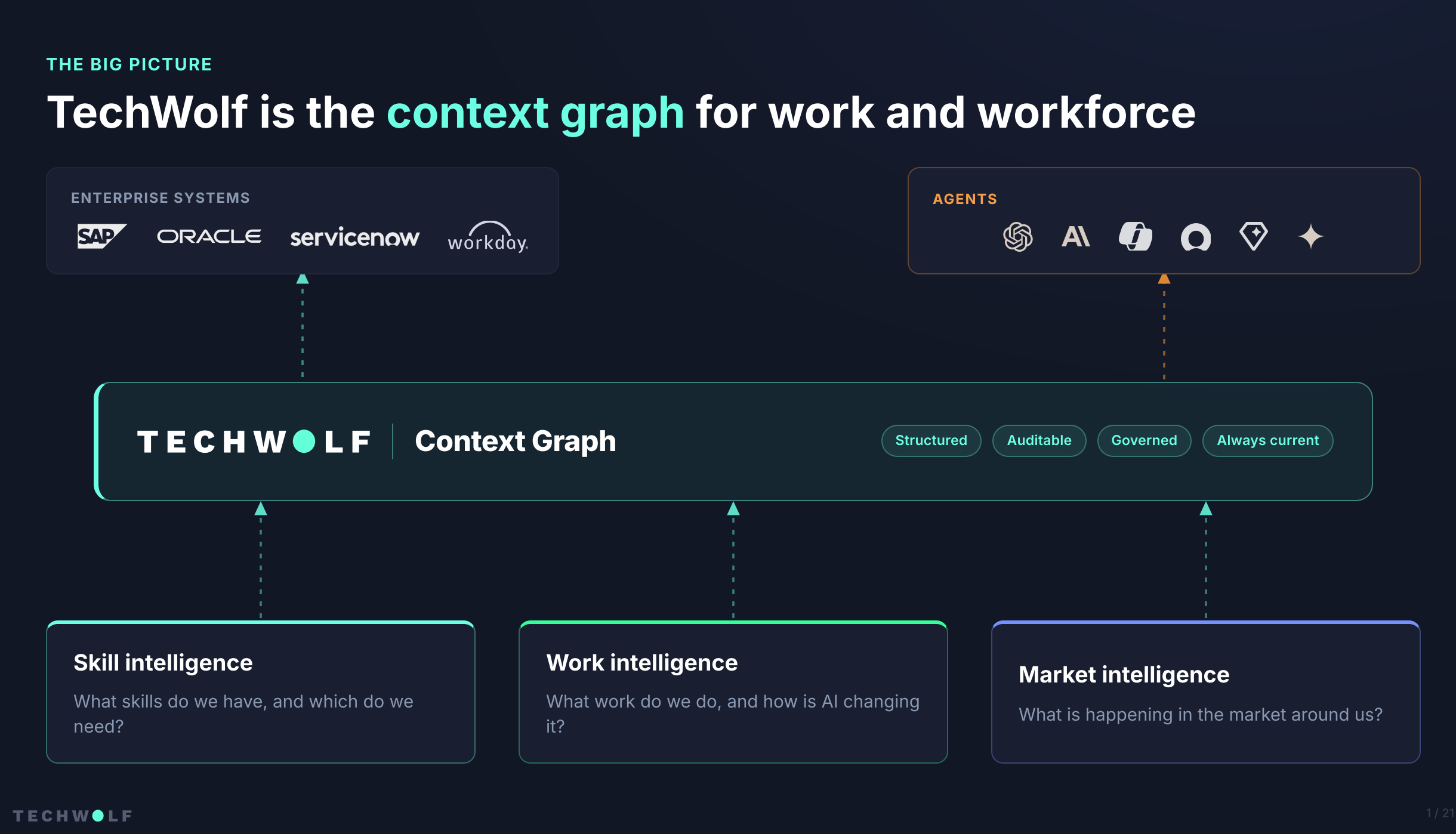
As business processes shift to a hybrid of agent and human interaction, data in the HCM system becomes critical beyond merely supporting HR processes, and data from Finance, CRM, and beyond enrich workforce planning and more. In one sense, this is a return to SAP co-founder Klaus Tschira’s vision, the goal of the HR system should be to help the business run better. The difference today is that the context layer and agents will enable a far richer and more flexible integration. Techwolf will play a vital role here.
The hard bit
TechWolf has spent several years leading the research in the AI / ML techniques to derive and infer skills and organization context in the flow of work. Unlike its competitors, TechWolf has always focused on data and AI, rather than on trying to build out an end-user experience for the HR buying centre. This was prescient, given that today the locus of UX is shifting towards agentic or chat based interaction. The future of UX is yet to be written, but it will involve a complex mix of human and agentic interaction. Techwolf is well placed to benefit from this.
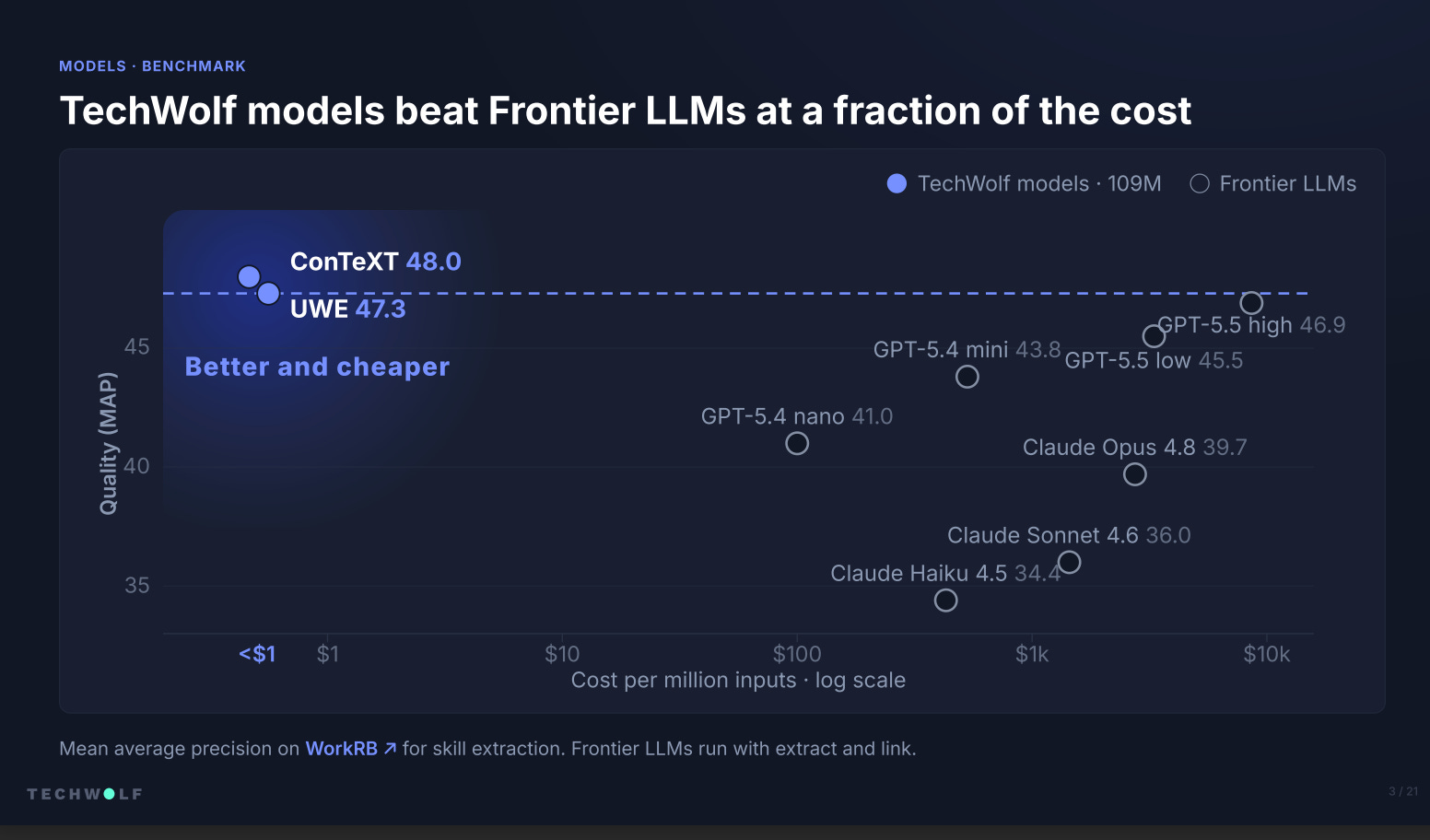
Together with the University of Ghent, the AI team has gone deep, and done the hard yards to combine deterministic and probabilistic AI techniques with nearly a decade of workforce data with robust GDPR aware providence. The models outperform generic LLMs on accuracy, validity and reliability. LLMs require 1000X the tokens yet achieve a lower quality output.
Under the technology leadership of Jeroen, Yaz and J-J, Techwolf has built the world’s best Worktech AI lab. If you know of a team with deeper Worktech AI chops than Techwolf do let me know.
Without understanding the people and organization context, organizations will spend tokens ineffectively. Techwolf has also built tokenspend.org, which allows companies to benchmark and optimize token usage and spend. Modelling AI spend in the context of work is not merely an accounting exercise.
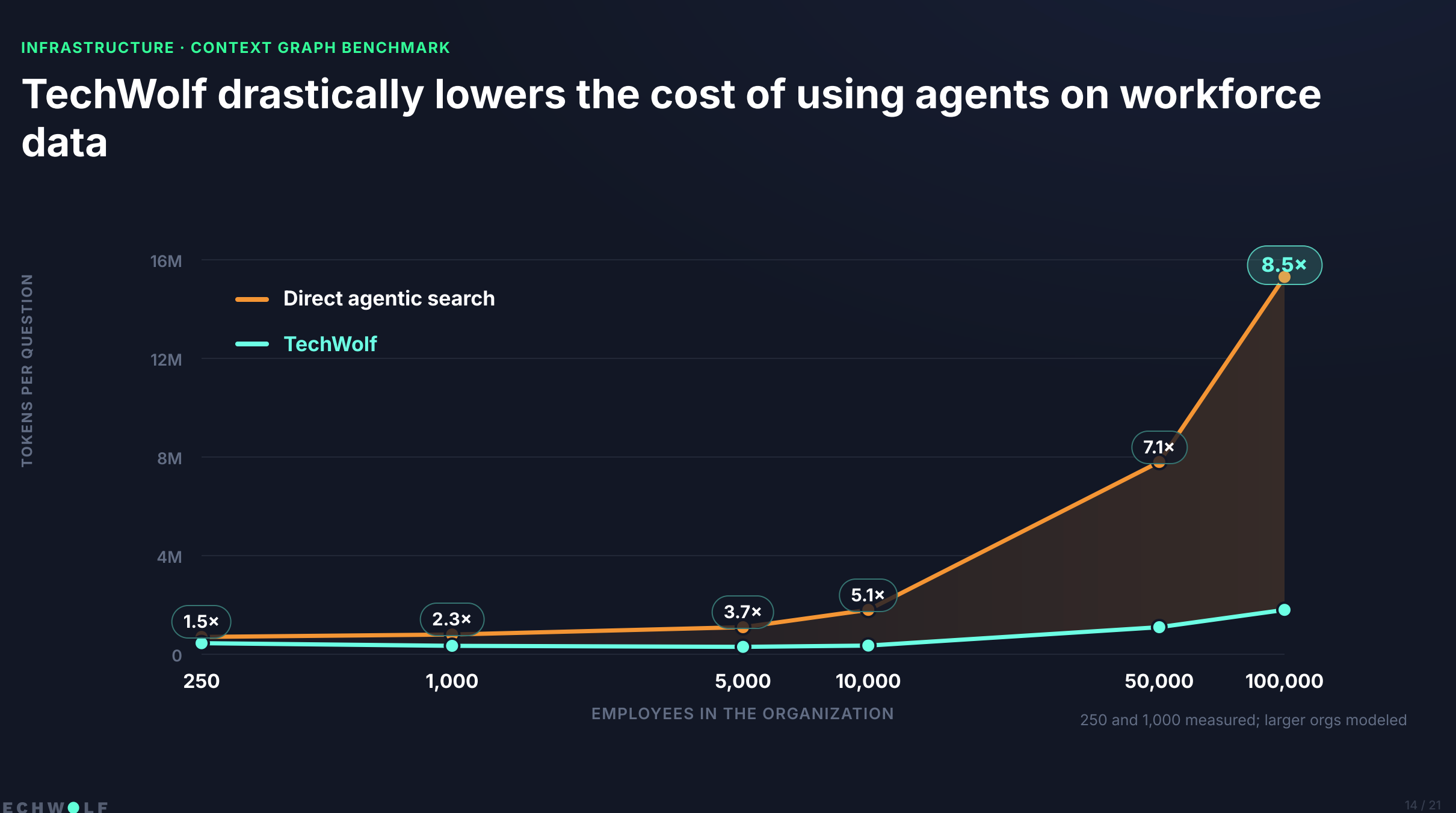
Techwolf can be a critical component of the context layer that controls, guides and optimizes agentic behaviour.
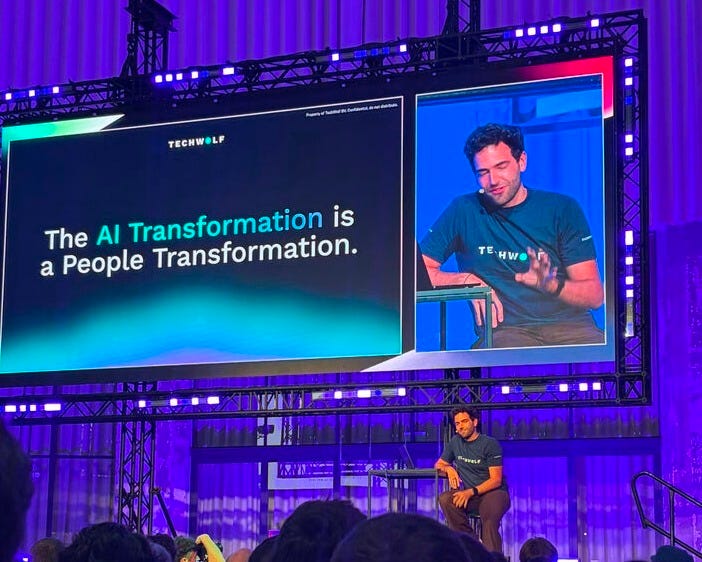
AI Transformation is People Transformation
Organizations actually deploying AI systems into enterprises know that change management is a massive challenge. Knowing who knows what, what jobs and tasks can be augmented, replaced or what new jobs must be created becomes a CEO level imperative. We believe Techwolf is the best product in the world to help CEOs, CFOs CHRO and other leaders understand, plan and enable large scale workforce transformation collaboratively. While HR is a strong champion for TechWolf, it now becomes a boardroom play too.
Workforce transition is fundamental to AI success. As organizations rethink the roles of HR and IT, TechWolf delivers the common language and trusted context to encourage that collaboration. It plays especially well with the relatively newly minted Chief Transformation Office.
How does this fit into SAP’s broader AI technology strategy?
I’ve no detailed access to SAP’s current strategy, so this is my conjecturing.
Like many of the incumbent ERP vendors, SAP is building out its AI capabilities and partner relationships. While it has a number of internally developed offerings, it is has made several earlier stage acquisitions and strategic investments3. See the acquisitions of Dremio, Reltio, and Prior Labs, and the recent strategic investments in n8n and Conduct. Also in 2023 SAP made investments in Anthropic, Aleph Alpha, and Cohere.
We expect it will do more these experimental investments over the course of 2027. AI is shifting the traditional partner / isv ecosystem. We have seen other incumbents such as ServiceNow, Workday and SalesForce make a series of acquisitions to.
SAP is largely leaving the new acquisitions to run independently. Over the last decade or so, SAP has significantly improved its post-merger-integration (PMI) competence (I have the scars). This is in part due to acquiring companies with a better cultural fit, for instance LeanIX and Signavio.
The biggest shift in SAP strategy in about a decade is the realisation that moving ECC customers to S/4 HANA is not enough. We argue that S/4 HANA related engineering and sales effort crowded out SAP’s ability to do other bolder developments.
However Venture Capitalists (and public market sell side analysts) have overestimated the vulnerability of the ERP vendors. They underestimate their hold over enterprise data. I explored this in more detail a couple of months ago.
Comments on A16Z's Why the World Still Runs on SAP.

I read with interest A16Z’s take on SAP. See footnote for disclosure and my enterprise software related background.
But to remain and enhance relevance in the longer-term SAP and other ERP vendors need to seriously step up their delivery of AI capabilities.
SAP’s acquisition strategy over the last 18 months or so provides clear evidence of that shift. SAP can now manage acquisitions more adroitly than it did in my day. A decade ago it was all about integrating (or forcing) them into SAP’s HANA technology. Today’s acquisition strategy is more about building differentiating AI capabilities. Injecting innovative technology through acquisition is an essential play for incumbent vendors.
Once the acquisition is bedded down, I expect to see product collaboration with Signavio, SAP’s process intelligence suite. Most process management software toda lacks the detailed skills and task data and context that TechWolf provides, so this would differentiate the Signavio proposition.
Rather than moving the AI labs under the central control of the application centric and proprietary HANA S/4 product, and rewriting on the HANA stack, SAP is building a network of collaborative but independent AI / deeptech labs. For instance Prior labs creates the opportunity to absorb the best AI talent in Southern Germany. It’s an attractive place for top graduates from Freiburg, KIT (my alumnus) Tüblingen and others. SAP is also strengthening its AI research efforts in Munich with TUM.
Similarly, Ghent punches well above its weight. It is a hot bed of dense AI innovation, for instance in cybersecurity. The collaboration between the university and start-ups is world class. Have a look the Wintercircus. TechWolf has built a strong AI team and research collaboration with the university. The TechWolf acquisition enables SAP to build an AI hub in Ghent, attracting the best minds from Belgium. It would not surprise me to see SAP make other Ghent plays, and ramp up hiring here.
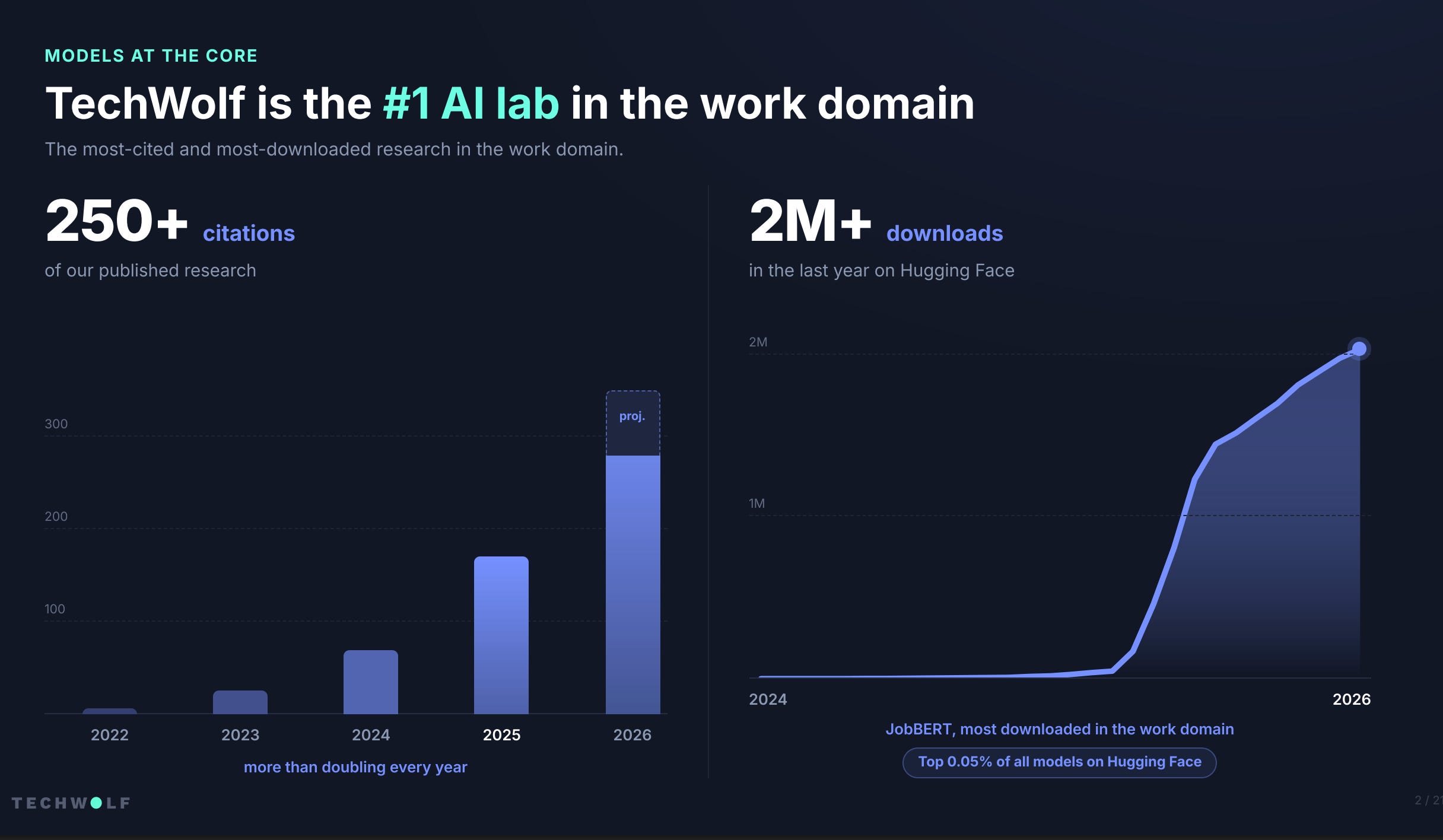
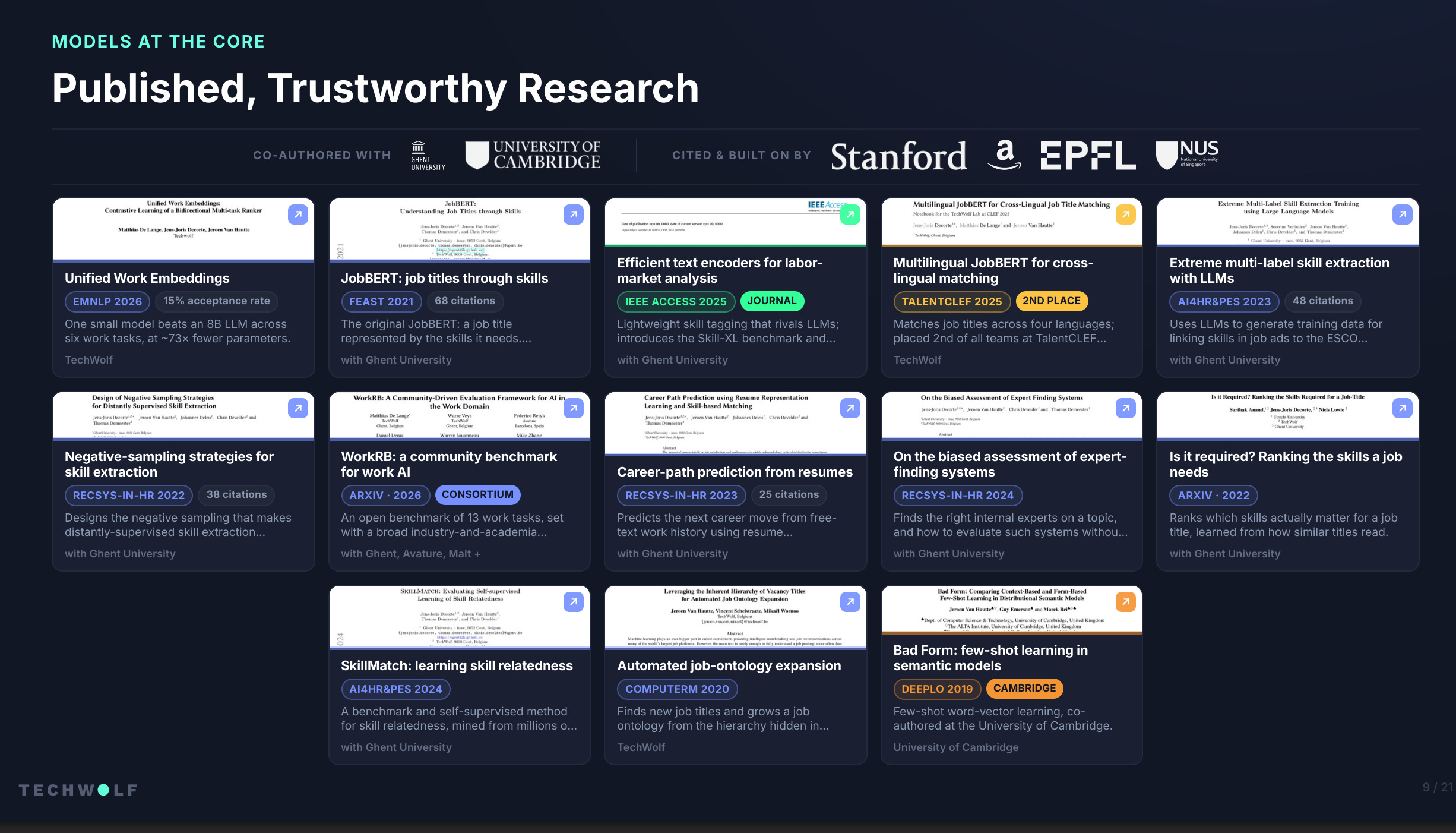
SAP has been active in AI related open source, for instance with its RPT-1. This aligns well with TechWolf’s open source first strategy, and its research focus. There is more to AI than LLMs. Here’s a look at Techwolf’s research output.
For incumbent vendors like SAP to be successful in the long term they need to develop what O’Reilly and Tushmann call the ambidextrous organization. SAP needs to exploit and explore simultaneously. For the last decade SAP has competently strengthened its business as usual (Exploit). Looking back, it has navigated the transitions from mainframe to client-server brilliantly and on-prem to SaaS adequately. It’s challenge now is to develop and deliver a compelling technical and commercially impactful AI offering. This can’t be done by simply refactoring ERP.
It requires boldness and a willingness to challenge historical assumptions. Its customers are undergoing an AI transformation. SAP needs to do the same with alacrity.
The acquisition of Techwolf fits snugly into that narrative. But the work starts now.
As I almost always do I end with a tune. It is not from Ghent but from Aalast, which is just down the road. It is a banger from 1989. Pump up the Jam. IFYKYK.
Addendum
Here are various Acadian Ventures posts that provide background on TechWolf’s development.
TechWolf, Deep Tech meets Work Tech, Context Graphs, transforming work

On Monday and Tuesday I was in Ghent. Ghent was massive hip start up spot in 1300 AD. It is now making a comeback, in part because of the efforts of local founders, the university, investors and the local government. TechWolf’s AI day attracted nearly 1000 people to the event at the Wintercircus. Most of them from the start up community.
When to go deep. Technical expertise. A bit about open source. Becoming the cognitive referent.

I have written how often founders get overly enamoured with talking about their technical wizardry (the recipe) to anyone who can’t escape the room without coherently first explaining the menu (why). This can lead extreme boredom and a lack of sales. See post below for more.
Techwolf's Series B, and a deeper reflection on skills management and AI.

Today Techwolf announced its Series B funding of $42,75 million.
Our Series A investment announcement on medium.
While I was an industry analyst at Gartner and a product leader at SAP for many years, I write this from my current perspective as a Venture Capitalist at Acadian Ventures. I’ve appended several posts that provide more context about our relationship with Techwolf.
Gartner predicts, “By 2030, HCM software spend will surpass $78 billion, driven by AI and HR modernization. As agentic AI expands, integration and compliance friction, along with tasks requiring human empathy, will limit automation. Vendors must address these barriers and evolve their pricing models to grow.”
Albert Pang makes a similar prediction: Worldwide HCM Applications Market to reach $81.1 billion by 2029, compared with $58.7 billion in 2024 at a compound annual growth rate of 6.7%.
HCM is roughly 10% of the enterprise applications market. https://www.appsruntheworld.com/topping-547b-in-2025-enterprise-applications-market-could-hit-753b-by-2030/
SAP made an investment in Techwolf’s series B, together with Workday and ServiceNow, so this is not an opportunistic play.
Great article Thomas and great move from SAP. This move truly places people at the centre of work transformation. Who knows what, who does what and what needs to be done. It was always the vision that “skills matching” could power advanced workforce decision making but the models were never achievable in practice. I love that SAP are going for the context layer and not just more AI add-ons. How good would it be to be building a new enterprise solution from the ground up again.
Congratulations, Thomas, to you and everyone at Acadian, and of course at TechWolf and SAP!!
(Now I’m bummed I didn’t go to SAP Connect this week!)
Amazing post, as usual, for anyone trying to see how this space is truly evolving, far beyond HR Tech.
Would love to get your thoughts on the enterprise AI governance layer (and specifically a new startup I’m partnering with).
Side note: I saw Technotronic perform at a Reebok-sponsored private party in 1990!